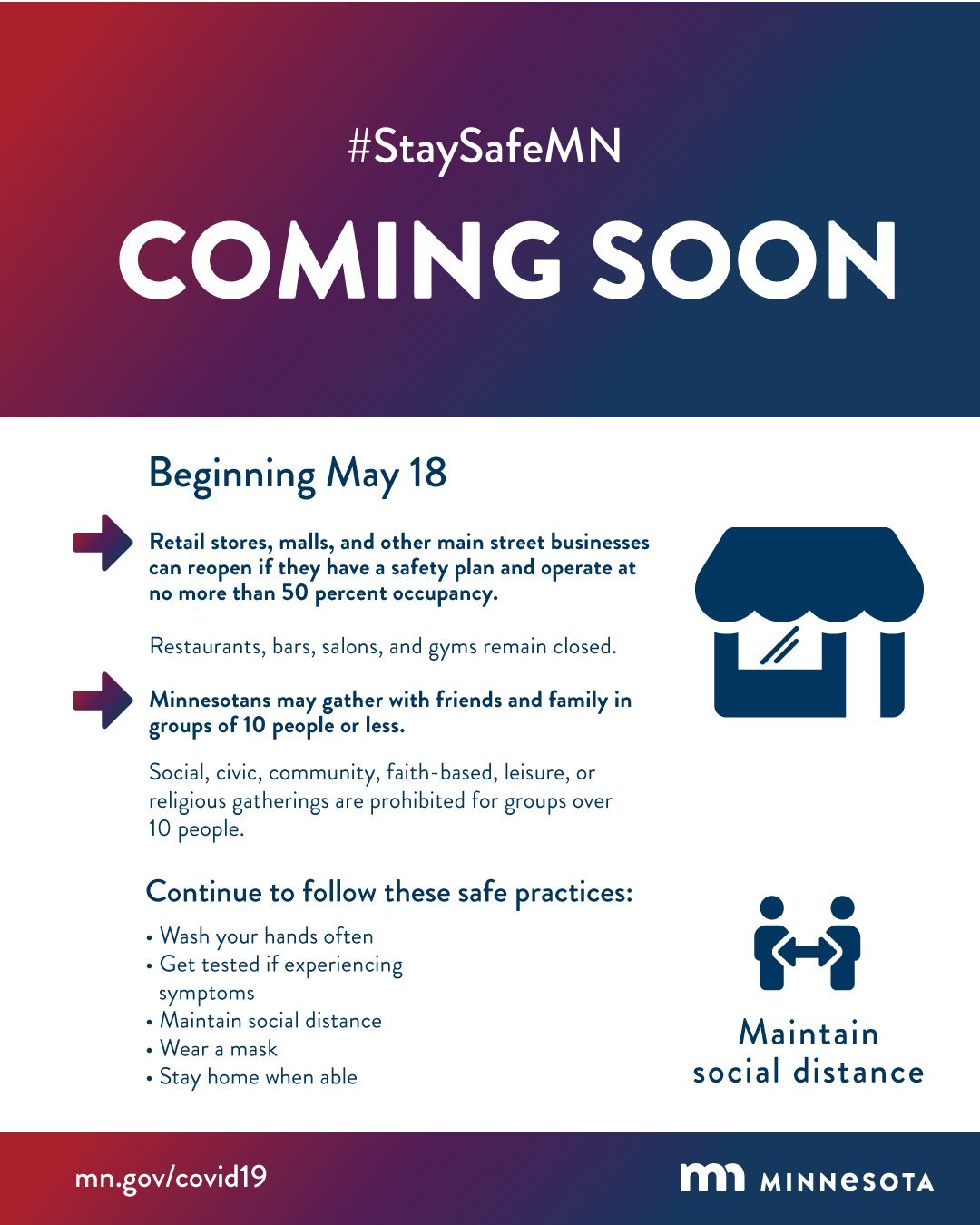
SAH ends May 18; Goal to open bars, restaurants June 1
May 15, 2020
Dear Friends and Neighbors,
Thanks to the thousands of Minnesotans who called, emailed, and wrote to Governor Walz, letting him know that Minnesotans could be trusted to safely get back to work.
Due to this, Gov. Walz announced he was lifting the state’s Stay at Home order effective Monday. This will allow the reopening of retail establishments and other businesses.
Unfortunately, many restaurants, salons, and other businesses, which have been planning for weeks to reopen, have been told they need to wait until June 1. This was disappointing — if businesses currently have a plan to safely operate, they should be able to do so. We need to trust our fellow Minnesotans.
I will continue to work to lend my voice to the fight to safely reopen every business in our state,.
Minnesota is prepared. Our hospitals have the capacity to deal with a potential surge. Please do not hesitate to reach out if I can be of any assistance.
Gov Peacetime Emergency & Bonding
Until the emergency powers end, we don’t know what the governor will do. That uncertainty makes it hard to understand the impact to our budget.
The bonding and government employee union contract bills are major items needing action. However, the billions Minnesota is getting from the federal government needs to be directed and spent in a defined way. As long as the governor keeps utilizing emergency powers, there is no guarantee where those funds will go. That uncertainty makes it difficult to pass the normal, regular, large spending bills.
I’ve been in the legislature when we have had multi-billion dollar deficits. What we do now will minimize the deficits and their impacts. We have been in session for two months, since the start of the emergency, working on and passing legislation to address the needs of our state. It is past time to end the emergency powers and return the balance between the branches of government.
This does not mean ending the good measures put into place, just removing the emergency power of the executive. It is less likely for 202 elected representatives of the people to miss something, or unintended consequences, than 1.
We need the governor to work with the legislature, even though it is tempting to do things with the wave of his hand.
Once it is appropriate to consider a bonding bill, I would consider supporting a bonding bill focused on core projects—safe water projects, road, bridges, etc. —but not the extra that has been stuffed into the House DFL Bonding Bill. We need to remember that the budget projection is just that—a projection— and we must be prudent with spending.
Absentee Ballot Request Available
Every eligible Minnesota voter can already vote from the comfort of their own home. The portal to request your ballot from the Secretary of State’s website went live this week for both the 2020 Primary and General elections.
You can now request your ballot at the Secretary of State’s website here.
2020 High School Graduates
Last week, the Minnesota Department of Education (MDE) released guidance banning graduation ceremonies statewide, regardless of class size or space available for the ceremony. Before they released their guidance, many legislators and school districts had already submitted plans to safely conduct their graduation ceremonies.
MDE has confirmed that they have not and will not create a policy to levy a financial penalty against schools holding graduation ceremonies in person.
Districts have been working on safe and creative plans, like having a car parade or holding the ceremony at a drive-in theater, that will allow them to recognize their graduating seniors while still keeping everyone safe and socially distanced. I would encourage every district to take all necessary safety precautions while recognizing this momentous occasion for high school graduates.
DEED Information on Safely Reopening
The Minnesota Department of Employment and Economic Development (DEED) provided the following information for businesses who are looking to reopen. This information comes directly from an email DEED sent out on Thursday:
Safely reopening and returning to work: What businesses and workers need to know
As Minnesota businesses begin the process of reopening and safely returning people to work, we know there are a lot of questions. We’ve answered many of the most common questions at mn.gov/deed/safework, and I encourage businesses and workers alike to review customized guidance there.
We also know that businesses and workers may be wondering about the process for bringing workers back into the workplace, and that many workers may have concerns about returning to the workplace given the threat of COVID-19. On May 13, Governor Walz issued Executive Order 20-54 which provides more clarity on worker protections in light of the COVID-19 pandemic.
We hope that this post will address some additional questions about how unemployment insurance works in this context.
Here’s what you need to know:
Most importantly, businesses must be safe and healthy for their workers and customers.
Businesses must follow all CDC and MDH guidance and OSHA standards about creating a safe and healthy environment for workers and customers.
A business may not take adverse action (including terminating, laying off or other retaliatory action) against a worker for raising safety and health concerns, refusing to work under conditions they reasonably believe are unsafe or unhealthy related to COVID-19, participating in union activities concerning work place safety and health issues, filing a safety and health complaint, or participating in an OSHA investigation.
In order to reopen, any non-Critical Sector business or retail establishment must have a COVID-19 Preparedness Plan in place to protect the health and safety of their workers.
Plans are extremely important to provide direction on how workers are going to remain safe. To help in the process, Minnesota Department of Health (MDH), DEED, and the Minnesota Department of Labor and Industry (DLI) have developed a template plan and guidance that businesses can use as a starting point. Businesses aren’t required to use this template, but a business’ plan does need to follow CDC and MDH guidelines and OSHA standards.
Wherever possible, workers should continue to work from home.
Businesses are encouraged to consult with workers on the development of their plans – it will make the plans better, proactively address many worker concerns and ensure workers are invested in the new norms businesses are setting.
We aren’t requiring businesses to submit their plans to the state for approval, but businesses should be prepared to provide a copy of your plan if requested.
Copies of the plan must be shared with workers in advance of reopening and posted at the workplace.
Once a COVID-19 Preparedness plan is in place and workers are called back to work, anticipate that some may be nervous or worried about returning to the workplace. Be flexible and provide necessary accommodations for workers.
This is an uncertain and challenging time, and many workers may have concerns about being back at work. Workers should also not have to sacrifice their health and safety for economic security. Businesses are encouraged to be as flexible as possible with workers, be responsive to requests for accommodations and ensure that you have provided appropriate protective gear in accordance with CDC and MDH guidance and OSHA standards – such as gloves if handling goods or money with customers, and non-medical face coverings.
Some employees may not be able to return to work.
Executive Order 20-05 provides a list of COVID-19 exemptions for workers, including those with underlying health issues or caretaking responsibilities.
Workers who qualify for these exemptions do not need to return to work and will continue to qualify for Unemployment Insurance benefits.
If a worker feels that their employer is not operating with a COVID-19 Preparedness Plan and/or not following health and safety protocols, there is action they can take.
Any worker who believes that their workplace is not following their COVID-19 Preparedness Plan or is not following CDC or Minnesota Department of Health guidelines is encouraged to attempt to resolve their concerns directly with their employer.
If the worker is not successful in that attempt, is not comfortable raising their concerns with their employer, or has additional concerns about the safety of their workplace, the worker should contact Minnesota OSHA at 651-284-5050 or email hidden; JavaScript is required.
If a worker raises concerns with an employer about not operating with a COVID-19 Preparedness Plan and/or not following health and safety protocols and the employer does not address the concern in a reasonable amount of time, the worker can quit and not lose unemployment insurance eligibility benefits as long as it was reasonable to do so.
If a worker is fired for raising concerns about workplace safety–either with Minnesota OSHA or directly with their employer–they will not lose unemployment benefits eligibility.
State Unemployment Insurance law prevents the state from continuing to pay benefits to those who are no longer eligible.
Workers who are offered the opportunity to return to work and don’t qualify for an exemption under Executive Order 20-05 or state unemployment insurance law are no longer eligible to receive benefits.
We ask every applicant on a weekly basis whether they have refused an offer of suitable employment. Providing inaccurate information may result in an applicant being held overpaid for unemployment benefits.
When workers return to work or want to stop requesting unemployment benefits, no additional notification is needed. They simply should stop requesting weekly benefits in their unemployment insurance account. Some additional information about unemployment and returning to work can be found here.
Under Minnesota law, businesses can “raise an issue” regarding a former employee’s eligibility for unemployment insurance
Businesses must follow all CDC and MDH guidance and OSHA standards about creating a safe and healthy environment for workers and customers. For non-Critical Sector businesses, this includes having a COVID-19 Preparedness Plan.
A business may not take adverse action (including terminating, laying off or other retaliatory action) against a worker for raising safety and health concerns, refusing to work under conditions they reasonably believe are unsafe or unhealthy related to COVID-19, participating in union activities concerning work place safety and health issues, filing a safety and health complaint, or participating in an OSHA investigation.
If a worker or employer notifies the department that an offer to return to work was refused, we will review the applicant’s eligibility for unemployment. What happens next?
DEED will mail questionnaires out to both the applicant and employer about why the applicant did not return to work – including questions about the applicant’s medical situation. A doctor’s note may be requested during any follow-up process for additional information.
Once the department has enough information to make a decision, a written determination about the applicant’s continued eligibility for unemployment will be provided.
At this point, either the applicant or employer can file an appeal within 20 calendar days. Minnesota Unemployment Insurance Law provides an opportunity for a fair and impartial hearing to any party who disagrees with a determination issued by the Minnesota Unemployment Insurance Program.
A telephone hearing and an appeals process follow from there, which will be outlined in detail to any worker or employer in this situation.
We know that both businesses and workers want to make the process of returning to work safe, effective, and fair. Thoughtful planning, clear communication, and a collaborative and generous spirit are going to get us through this difficult time.
We hope these guidelines make it clear how this process will work, and we encourage everyone to get more information in the FAQ section of UIMN.org.
Please Stay in Touch
Please continue to stay in touch to share your thoughts or concerns. My phone number is 651-296-9236 or you can email me at email hidden; JavaScript is required.